How to Choose the Right Oil Skimmer for Heavy, Medium, and Light Oils
Choosing an oil skimmer gets easier when the oil itself leads the conversation. Heavy oil, medium crude, diesel, light fuel oil, weathered oil, and emulsified oil do not behave the same way on water. They spread differently, cling differently, pump differently, and change with temperature. A skimmer that works well on diesel in a calm separator may struggle with cold bunker fuel in open water. The best oil skimmer for heavy oil is not always the biggest unit on the dock. It is the skimmer, recovery surface, pump, and operating setup that match the oil’s viscosity and the job site.
This selection guide turns oil type and viscosity into a practical framework for spill response teams, oil and gas operators, terminals, refineries, industrial facilities, and OSROs. It is not meant to replace site-specific engineering or response planning. It is meant to help narrow the choice before the equipment is mobilized.
Start With the Oil, Not the Skimmer
Every oil recovery job starts with a few basic questions. What oil are you trying to recover? How thick is it right now? Has it weathered or emulsified? Is the oil warm and flowing, or cold and stiff? Is the slick thick enough to feed a skimmer, or are you chasing a thin sheen across a wide area?
Oil type is a useful starting point, but viscosity is what usually drives the equipment decision. Viscosity is the oil’s resistance to flow. Light oils move easily. Heavy oils resist movement. Cold weather, evaporation, water-in-oil emulsification, and aging can all make an oil act heavier than it did when it was first released.
For practical selection, most response teams can begin by grouping oils into three working categories:
- Light oils: diesel, jet fuel, gasoline-range products, light refined fuels, and some light crude oils.
- Medium oils: many crude oils, fuel oils, hydraulic oils, lubricating oils, and oils that have begun to thicken or weather.
- Heavy oils: heavy crude, bunker fuels, asphaltic products, cold oil, waxy oil, and emulsified oil that clings instead of flowing freely.
Those categories are not hard lines. A medium crude in July may behave like a much heavier oil in January. A light oil may become harder to recover after spreading into a thin film. The job is to match the skimmer to the condition of the oil in front of you, not just the product name on a safety data sheet.
The Practical Selection Framework
A good skimmer selection process should move through five questions in order:
- What is the oil viscosity at the expected recovery temperature?
- Is the oil fresh, weathered, emulsified, or mixed with debris?
- Is the work area inland, industrial, harbor, nearshore, or offshore?
- How much oil must be recovered, and how quickly?
- Can the pump, hose, power source, and storage keep up with the skimmer?
That last point matters. Skimming is a system. The recovery surface gathers oil. The trough receives it. The pump moves it. The hose carries it. Storage holds it. If any one part is undersized, the whole system slows down. Heavy oil especially will expose weak links in pump selection, hose length, suction lift, and storage logistics.
Light Oils: Prioritize Selectivity and Control
Light oils spread fast. They may form thin slicks, move with wind and current, and evaporate more quickly than heavier products. Because light oils often do not build a thick floating layer, the skimmer needs to recover oil without bringing in a lot of water.
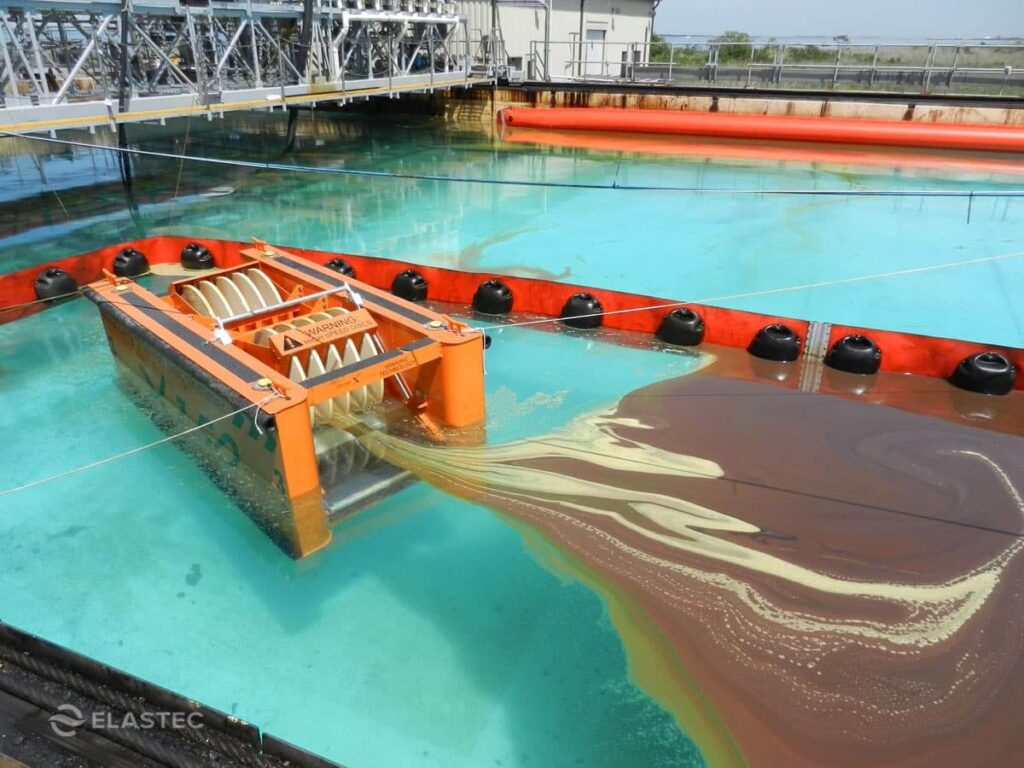
For many light-oil applications, a smooth drum skimmer can be a good fit. Smooth oleophilic drums provide a clean surface for oil to adhere to, and they can be efficient when the oil is light enough to spread evenly across the drum face. In an industrial separator, sump, pit, creek, river, or small harbor, a compact drum skimmer may be the right practical answer.
Elastec examples may include the Mini Skimmer, MiniMax, or TDS118 depending on the job size, access, and required recovery rate. The TDS118 is often considered when the response area requires a shallow draft, portable skimmer that can work in creeks, rivers, lakes, oil pits, and API separators. For trace oil recovery or continuous industrial duty, smaller skimmers may be more practical than mobilizing a larger system.
Selection notes for light oil
- Use containment to thicken the slick before skimming. Thin oil spread over a large area is hard for any skimmer to recover efficiently.
- Avoid overpowering the recovery point. A high-capacity pump can pull water if the skimmer is not being fed enough oil.
- Look at water pickup, not just gallons per minute. A high water cut creates storage and disposal problems.
- Consider vapor hazards, site safety rules, and power source requirements before choosing hydraulic, pneumatic, diesel, or electric equipment.
Medium Oils: Balance Recovery Rate, Efficiency, and Portability
Medium oils are where many drum skimmers earn their keep. This category includes a broad range of crude oils, lubricants, fuel oils, and oils that have thickened but still flow. Medium oil may cling well to oleophilic drums or discs, but it may also require more torque, a larger sump, and a pump that can move the recovered product without clogging or cavitating.
For medium oils, grooved drum technology is often worth considering. Grooves increase the surface area and help carry more viscous oil into the skimmer. Compared with smooth drums, grooved drums can improve recovery rate when the oil has enough body to cling to the drum surface. This can be useful in oil pits, terminals, inland spills, harbors, and nearshore work where the oil is thick enough to build a recoverable layer.
Elastec examples may include the TDS118 or TDS136 for inland, industrial, and harbor applications, or a Magnum 100 when a larger floating drum system is needed for harbors, coastal waters, rivers, and lakes. The right choice depends on access, oil volume, available lifting equipment, sea state, and storage capacity.
Selection notes for medium oil
- Choose smooth drums when efficiency with lighter product is more important than maximum recovery rate.
- Choose grooved drums when the oil is more viscous and the operation needs higher throughput.
- Match the pump to the oil. Medium oils may require a more robust pump than light fuels.
- Check hose runs. Long discharge lines, small hose diameters, and cold temperatures can slow recovery.
- Plan for debris. Floating trash, vegetation, and sorbents can interfere with skimming and pumping.
Heavy Oils: Build Around Viscosity
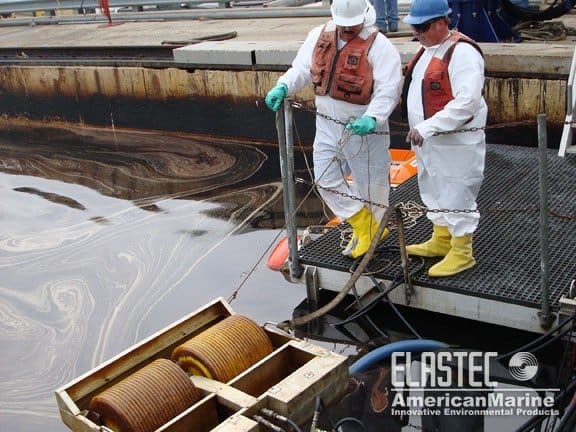
Heavy oil changes the selection process. The best oil skimmer for heavy oil is usually one built around adhesion, torque, heat management, and pumping. Heavy oils do not always flow to the skimmer. They may pile up, form mats, emulsify, or cling to debris. In cold conditions, they can become even harder to move.
For heavy oils, grooved drums and brush drums are often the first recovery surfaces to evaluate. Grooved drums can carry more viscous oil than smooth drums. Brush skimmers can be especially helpful when oil is heavy, sticky, weathered, or emulsified. The bristles give heavy oil more surface to cling to, and the oil is then scraped from the brush into a collection area.
A heavy-oil setup also needs the right pump. A skimmer may recover oil at the surface, but if the pump cannot move that oil into storage, the job stalls. Heavy oil may call for a heavier-duty pump, larger hose, shorter hose runs, lower suction lift, heat, or steam coils. On cold jobs, heating the recovered oil can help it flow and prevent freezing or blockages.
Elastec examples may include TDS118 or TDS136 skimmers with grooved drum configurations for viscous oils, brush drum skimmers for heavy or emulsified oil, the Filterbelt Skimmer for heavy oil and debris-laden conditions, and larger weir skimmers such as Magnum models where the incident requires higher-volume recovery. The right choice depends on whether the oil needs more adhesion, more free-flowing intake capacity, more pumping power, or more support equipment to keep heavy product moving.
Selection notes for heavy oil
- Think beyond the skimmer head. Pump, hose, fittings, heat, and storage are part of the heavy-oil recovery system.
- Use grooved drums or brush surfaces when smooth drums cannot carry enough oil.
- Reduce unnecessary hose length and avoid tight bends that add friction.
- Consider heating options when cold temperatures make oil difficult to pump.
- Expect lower real-world throughput if the oil is emulsified, debris-laden, cold, or scattered.
A Quick Selection Matrix
The table below gives a practical starting point. Final selection should account for site conditions, safety requirements, volume, logistics, and test data.
| Oil condition | Typical behavior | Recovery surface to consider | Pump/system notes | Relevant Elastec examples |
|---|---|---|---|---|
| Light oil | Spreads quickly; may form thin slicks; may evaporate faster | Smooth drum; selective oleophilic surface | Control water pickup; contain oil before skimming; match pump to slick thickness | Mini Skimmer, MiniMax, TDS118 |
| Medium oil | Flows but has body; often clings well to oleophilic surfaces | Smooth or grooved drum depending on viscosity and recovery-rate needs | Use a pump and hose sized for thicker product; watch debris and temperature | TDS118, TDS136, Magnum 100 |
| Heavy oil | Sticky, slow-moving, may be cold, weathered, or emulsified | Grooved drum, brush drum, or grooved disc for higher-volume work | Plan for torque, heating, heavier pumps, shorter hose runs, and storage | Brush Drum Skimmer, TDS118/TDS136 grooved drum, Filterbelt Skimmer, larger weir skimmers, Magnum models |
Do Not Let Viscosity Be the Only Factor
Oil type is important, but it is not the only selection factor. A response team also has to consider where the work is happening. An inland creek is not the same as a refinery separator. A harbor job is not the same as an offshore recovery operation. The best skimmer for one setting may be too large, too small, too heavy, or too difficult to support in another.
Important site questions include:
- Is the site accessible by truck, boat, crane, ATV, or hand carry?
- How deep is the water, and is the skimmer draft appropriate?
- Is the water calm, flowing, choppy, or affected by tide and wind?
- Can boom be used to concentrate oil and improve encounter rate?
- Is the area classified or hazardous, requiring pneumatic operation or other safety controls?
- Is recovered oil going to a tank, vacuum truck, bladder, barge, or temporary storage?
The right answer often comes from pairing the oil condition with the working environment. A small skimmer may be the best fit for a separator where oil accumulates steadily. A larger drum or disc system may be needed when a response team must recover a thick slick quickly in open water. A brush drum may be the better tool when the oil has weathered and emulsified. The framework is practical because it follows the job, not a sales sheet.
Think in Terms of Encounter Rate
Oil skimmers only recover oil they can reach. Encounter rate is the amount of oil presented to the skimmer over time. If the oil is spread thin, the skimmer can sit in the water and still recover slowly. Containment boom, current control, vessel movement, skimmer placement, and recovery pattern all affect how much oil reaches the recovery surface.
This matters for all oil types, but it is especially important with light oils and offshore work. A high-capacity skimmer cannot perform like a high-capacity system unless the oil is being fed to it. Likewise, a heavy-oil skimmer needs a thick enough oil layer and enough time for the recovery surface to load.
Pump Selection Can Make or Break the Job
It is easy to focus on the skimmer head and overlook the pump. That is a mistake. The pump must move the recovered oil without adding unnecessary water, breaking emulsions in an unhelpful way, clogging with debris, or losing prime. Light oils may move easily, but heavy oils may need a pump with more torque and a discharge system designed for viscous product.
When selecting the pump, consider oil viscosity, temperature, suction lift, discharge distance, hose diameter, elevation change, and solids or debris. For heavy oil, shorter and larger discharge lines are often better. Heating may also be needed. In cold conditions, the pump and hose can become the limiting factor even when the skimmer itself is doing its job.
When the Oil Has Weathered or Emulsified
Weathered oil deserves special attention. As lighter fractions evaporate and water mixes into the oil, the product can become thicker and more difficult to recover. An oil that started as a medium crude may behave like heavy oil after weathering. Emulsified oil may cling better to brush or grooved surfaces than to smooth drums, but it can also be harder to pump and store.
For this reason, responders should reassess skimmer choice as a spill evolves. Early response may require one setup. Later recovery may require a different drum insert, brush system, pump, or heating plan. A flexible system can be a real advantage when oil conditions change over the course of a response.
Common Selection Mistakes
Most skimmer selection mistakes come from treating one specification as the whole answer. Recovery rate matters, but it is not the only measure. Water pickup matters. Mobility matters. Pumping matters. Storage matters. Safety matters.
- Choosing only by maximum recovery rate instead of real site conditions.
- Using a smooth drum on oil that has become too viscous to carry well.
- Choosing a skimmer without matching the pump to the recovered oil.
- Ignoring cold weather and assuming oil will pump the same way it did in warm testing.
- Letting oil spread too thin before recovery begins.
- Underestimating storage, transfer, and disposal requirements.
A Plain-Spoken Rule of Thumb
For light oils, start with selectivity and control. Keep water pickup low, contain the slick, and use a skimmer sized to the actual oil layer.
For medium oils, balance recovery rate and efficiency. Smooth drums may work well when the product is still relatively light. Grooved drums become more attractive as viscosity increases and recovery-rate needs rise.
For heavy oils, build the system around viscosity. Look at grooved drums, brush drums, heavier pumps, heating, hose layout, and storage. The best oil skimmer for heavy oil is the one that can pick up sticky oil and keep it moving after it leaves the water.
Final Takeaway
The right oil skimmer is chosen by the oil, the site, and the response goal. Heavy, medium, and light oils each call for a different balance of adhesion, selectivity, pumping power, portability, and throughput. Start by identifying how the oil behaves at the expected recovery temperature. Then match the recovery surface, pump, hose, power source, and storage to that behavior.
For oil and gas operators and OSROs, this approach keeps the selection process grounded. It helps avoid overbuying, under-sizing, or choosing equipment that looks right on paper but struggles in the field. When oil type and viscosity lead the decision, the skimmer choice becomes more practical, more defensible, and more likely to perform when the call comes in.
Ask Elastec to help configure an oil skimmer system for your oil type, viscosity, site conditions, and recovery goals.
Connect With Us
Sign up for our newsletters to receive the latest news and product information from Elastec.