
Types of Oil Skimmers & How They Work
Écumeurs d'huile remove oil floating on water so it can be transferred to storage for recycling, treatment or disposal. Although every skimmer performs the same basic job, different designs collect oil in different ways. Some allow the surface layer to flow over a weir, while others use oil-attracting drums, discs, brushes or belts. Suction skimmers draw surface liquids directly into a recovery system.
The right design depends on the oil, slick thickness, water conditions, debris, deployment method and the supporting pumps and storage available. Understanding how each mechanism works makes it easier to select a system that balances recovery rate, oil selectivity and practical field requirements.
What Is an Oil Skimmer
An oil skimmer is a mechanical device that collects oil from the surface of water. Skimmers are used during spill response in rivers, lakes, harbors, coastal waters and offshore environments. Fixed or mounted systems may also remove unwanted oil from tanks, pits, lagoons and industrial process water.
A skimmer is only one part of a recovery system. Depending on the application, the complete setup may also include containment boom, a pump or vacuum source, hoses, a power unit and temporary storage. Each component must be compatible with the viscosity of the recovered product and the required transfer distance.
How Oil Skimmers Work
Most skimmers take advantage of the way oil behaves at the oil-water interface. Many petroleum products are less dense than water, so they tend to float and form a surface layer. Density is not the only factor, however. Oil and water do not mix readily, and interfacial tension helps keep the liquids separated while influencing how the oil spreads into a slick. Weathering, emulsification, sediment and turbulence can change that behavior, so not every spilled product remains as a clean, uniform layer.
Surface chemistry also determines how a liquid wets a solid material. Oleophilic surfaces have a stronger affinity for oil than for water. When an oleophilic drum, disc, belt or brush passes through a slick, oil coats the collection surface. Scrapers or wipers then remove the oil and direct it into a sump. This selective process generally recovers a higher concentration of oil than a device that takes in the entire surface layer.
Weir and suction skimmers use a different approach. A weir is positioned at or just below the oil-water interface so the surface layer flows into a hopper. A suction head uses negative pressure to draw surface material into a hose. These non-selective methods can provide high total-fluid recovery, but they may collect more water along with the oil.
The Oil Recovery Path
- Oil is contained or concentrated where the skimmer can encounter it.
- The skimming head collects the slick by overflow, adhesion or suction.
- Wipers, scrapers, gravity or suction move the recovered liquid into a sump or hose.
- A pump or vacuum source transfers the oil or oil-and-water mixture to temporary storage.
- The recovered material is separated, recycled, treated or disposed of according to the response plan and applicable requirements.
The Main Types of Oil Skimmers
Oil skimmers can be grouped by their recovery mechanism. Within each group, size, materials, pumping systems and deployment configurations can vary widely.
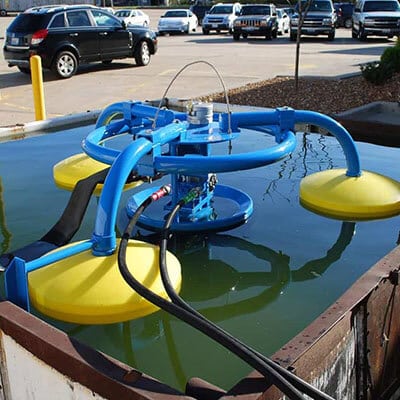
Écumoires Weir
A weir skimmer removes the uppermost layer of liquid. Oil and some water flow over an adjustable or self-adjusting edge into a central hopper, where the recovered fluid is pumped to storage. Because any liquid at the surface can cross the weir, these skimmers are considered non-selective.
- Useful when high total-fluid recovery is important or when the oil is too thick or irregular for a selective surface.
- Can handle many oils that remain fluid enough to flow over the weir.
- May collect substantial water, especially in waves or when the weir is set too low.
- Floating debris can interfere with the inlet or downstream pump.
See Elastec’s weir oil skimmers.
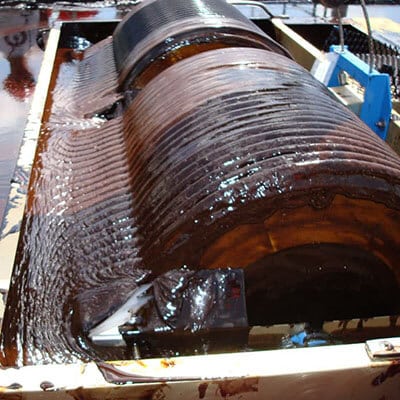
Écumoires de tambour
Drum skimmers use rotating oleophilic drums that pass through the oil layer. Oil adheres to the drum surface while much of the water drains away. Wiper blades remove the oil and direct it into a collection trough for pumping to storage.
- Selective recovery can reduce the amount of water sent to storage.
- Smooth, grooved or interchangeable collection surfaces can be matched to different oils and operating conditions.
- Performance depends on oil viscosity, slick thickness, drum speed and the ability of oil to reach the drums.
See Elastec’s écumeurs à huile de tambour.
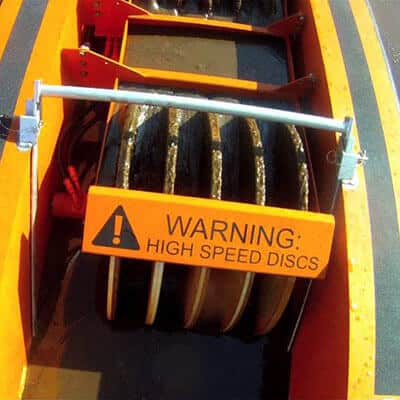
Skimmers de disque rainuré
Disc skimmers use a bank of rotating oleophilic discs. As the discs move through the slick, oil coats their surfaces. Scrapers remove the oil on each rotation and direct it into a sump. Multiple discs provide collection area in a compact skimming head, while grooves can increase the surface available to carry oil.
- Selective collection generally limits excess water recovery.
- Disc geometry and rotational speed should be matched to the oil and operating environment.
- Debris management and regular inspection of scrapers are important for consistent operation.
See Elastec’s grooved disc skimmers.
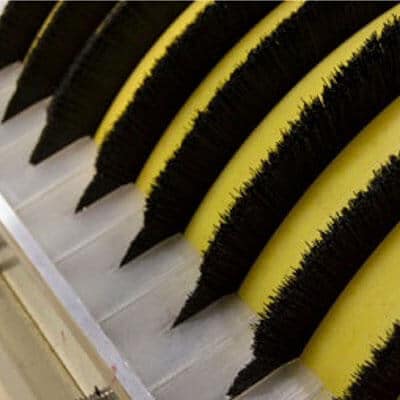
Skimmers à brosse
Brush skimmers collect oil on rows of oleophilic bristles. The brushes rotate through the slick and are combed or scraped as they return to the skimmer, releasing the recovered oil into a sump. Brush stiffness and spacing affect the oils the skimmer can handle.
- Often considered for viscous, weathered or emulsified oils that cling to the bristles.
- Can be configured as a standalone unit, incorporated into a vessel or fitted to another skimmer design.
- Bristles and cleaning components require inspection when operating around debris.
See Elastec’s brush drum skimmer.
Écumoires de ceinture
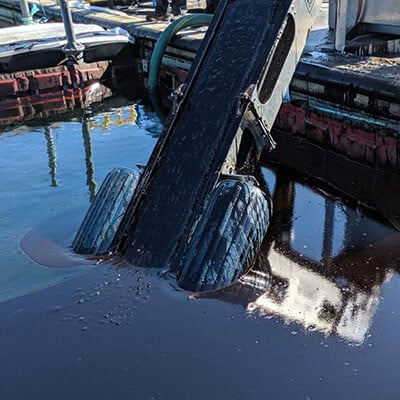
Belt skimmers move a continuous oleophilic belt through the oil. The belt carries oil out of the water, and a scraper or wringer removes it into a sump or tank. Small fixed belt skimmers are common in industrial applications, while larger floating or advancing belt systems can be used in spill response.
- The belt can reach into tanks, pits or confined areas where the drive assembly must remain above the liquid.
- Belt material and surface design can be selected for different oils and temperatures.
- Alignment, tension, scraper condition and debris loading affect operation.
See Elastec’s FilterBelt oil skimmer.
Suction and Vacuum Skimmers
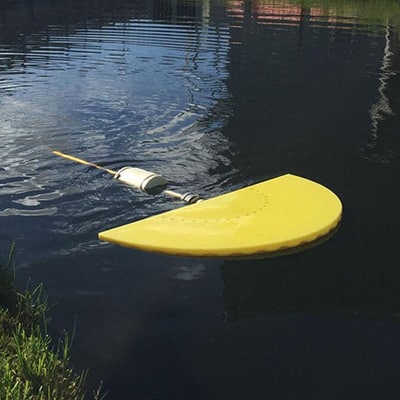
Suction skimmers use a floating head or pickup tool connected to a pump or vacuum system. The operator positions the inlet at the oil-water interface, and negative pressure draws the surface liquid through a hose to a recovery tank. Because the system collects what enters the inlet, it is non-selective.
- Portable and useful where a hose can reach pooled or contained oil.
- Can recover oil, water and small debris together, increasing storage and separation needs.
- Hose diameter, suction lift, pump compatibility and clogging potential must be considered.
Explore Elastec’s systèmes à vide.
Floating Fixed and Advancing Skimmers
The collection mechanism is only one part of skimmer selection. Deployment configuration also matters.
- Floating skimmers operate at the water surface and may be held with lines, deployed from shore, or operated from a vessel.
- Fixed or mounted skimmers remain in a tank, pit, separator, or other controlled location for routine oil removal.
- Stationary spill-response skimmers recover oil that is brought to the skimming head by boom, current, or manual positioning.
- Advancing skimmers move through the slick or use vessel motion to bring oil into the recovery system. Their performance depends strongly on encounter rate and operating speed.
How to Select the Right Oil Skimmer
Start with the conditions in which the complete recovery system must operate. The following factors influence both skimmer choice and field performance.
- Oil properties. Identify the product, expected viscosity, weathering, emulsification and operating temperature.
- Slick thickness and encounter rate. A skimmer cannot recover oil faster than oil reaches its collection surface.
- Water conditions. Waves, current, wind and vessel motion can change inlet position, increase water pickup and move oil away from the skimmer.
- Debris and ice. Floating material can block weirs, foul brushes or discs, and clog hoses or pumps.
- Required oil selectivity. Limited storage or downstream separation capacity may favor a system that minimizes water pickup.
- Pump and hose compatibility. The recovered fluid must move through the pump and discharge hose at the expected viscosity and lift.
- Storage capacity. Total-fluid recovery, not just oil recovery, determines how quickly tanks fill.
- Deployment resources. Consider personnel, boats, cranes, vehicles, power, compressed air and available access to the spill.
- Operating environment. Hazardous or corrosive conditions may require compatible materials and an appropriate drive system.
- Readiness and maintenance. Inspect collection surfaces, scrapers, seals, hoses, pumps and power units, and train operators before an incident.